
Application deadline: 4 October 2026
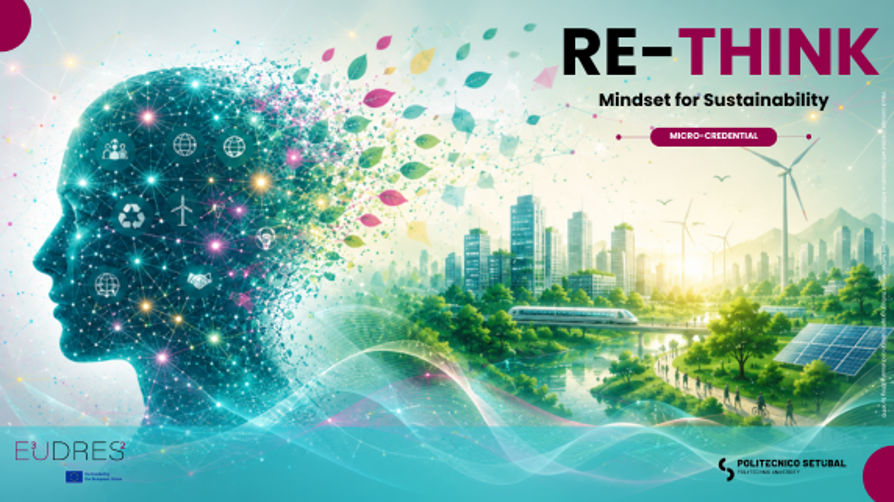
RE-Think – Mindset for Sustainability” is an action-oriented micro-credential designed to foster a sustainability-oriented mindset among master’s students and equip them with the competencies required to address complex sustainability challenges in both professional and societal contexts.
Grounded in the RE-Think framework- Reconsider, Eliminate, Transform, Huge Opportunities, Include, Nurture, and Keep – the programme provides participants with conceptual and practical tools to critically examine existing habits, systems, and decision-making processes through the principles of sustainability.
The micro-credential encourages learners to identify opportunities for innovation, adopt systems thinking, engage with diverse stakeholders, cultivate sustainable behaviours, and promote resource efficiency and circularity. By integrating these perspectives, participants will develop the capacity to design and implement more sustainable solutions across a range of contexts.
Through an interdisciplinary and practice-oriented learning approach, RE-Think supports the development of critical thinking, responsible leadership, and transformative competencies that are increasingly essential for advancing sustainable development in a rapidly changing world.
Details
Course Content
Module 1: Reconsider – Addressing Current Sustainability Challenges
- The Triple Bottom Line
- Circular Economy
- Green Economy
- Blue Economy
- Doughnut Economics
Module 2: Eliminate – Reducing Waste and Inefficiency
- Understanding waste: materials, energy, and time
- Electronic waste (e-waste)
- Strategies for eliminating disposable, non-essential, and harmful elements
Module 3: Transform – Redesigning for Sustainability
- Innovation for circularity
- Sustainable circular business models
- Real-world examples of transformative change
Module 4: Huge Opportunities – Creating Shared Value
- Corporate Social Responsibility
- Creating Shared Value
Module 5: Include – Engaging All Stakeholders
- Stakeholder theory
- Community engagement, co-creation, and equity in sustainability initiatives
Module 6: Nurture – Building Sustainable Habits for Long-Term Impact
- Behaviour change
- The role of leadership
- Consumer awareness
Module 7: Keep – Closing the Loop
- Circular economy in practice: reuse, repair, recycle, redesign, and other circular strategies
- Maintaining value within the system through policy and innovation
Course Times
Synchronous sessions:
13 October 2026, 18:00–21:30 (Portuguese time) | 19:00–22:30 (CEST)
20 October 2026, 18:00–20:00 (Portuguese time) | 19:00–21:00 (CEST)
27 October 2026, 18:00–20:00 (Portuguese time) | 19:00–21:00 (CEST)
03 November 2026, 18:00–20:00 (Portuguese time) | 19:00–21:00 (CEST)
10 November 2026, 18:00–20:00 (Portuguese time) | 19:00–21:00 (CEST)
17 November 2026, 18:00–20:00 (Portuguese time) | 19:00–21:00 (CEST)
24 November 2026, 18:00–20:00 (Portuguese time) | 19:00–21:00 (CEST)
01 December 2026, 18:00–20:00 (Portuguese time) | 19:00–21:00 (CEST)
08 December 2026, 18:00–20:00 (Portuguese time) | 19:00–21:00 (CEST)
15 December 2026, 18:00–20:00 (Portuguese time) | 19:00–21:00 (CEST)
22 December 2026, 18:00–21:00 (Portuguese time) | 19:00–22:00 (CEST)
05 January 2027, 18:00–21:30 (Portuguese time) | 19:00–22:30 (CEST)
Tutors
Carmina Nunes (IPS)
Study Programme
Carmina Nunes (IPS)
ECTS
5 (check “Recognition of ECTS” section for more information)
Contact Hours
48 (28 synchronous, 20 asynchronous)
Prerequisites
Bachelor degree
Further information
Recognition of ECTS
Please note that the recognition of the ECTS provided through this activity on your Transcript of Records depends on the decision of the responsible E³UDRES² coordinators or academic authority of your study programme at your home institution. We strongly recommend contacting them before starting an activity that awards ECTS in order to avoid any unexpected difficulties later on.
Depending on their decision, one of the following scenarios may apply:
- Your credits are recognised and can replace another course within your regular study programme.
- Your credits are recognised and can be included in the elective or free-choice space of your study programme (if applicable).
- Your credits are recognised as extra-curricular, meaning they cannot replace another course or be included in the elective or free-choice space of your programme (if applicable).
When contacting the responsible E³UDRES² coordinators at your home institution, please ensure you provide all relevant information about the E³UDRES² activity so they can properly evaluate your request.
Teaching Methods
The course adopts active, student-centred learning methodologies that take into account participants’ diverse academic backgrounds and respond to their specific learning needs.
These active learning methodologies are based on four core principles:
- Co-creation: the formation of collaborative teams comprising students with diverse academic and professional backgrounds;
- Multidisciplinarity: bringing together students from different higher education disciplines, including those from IPS and other higher education institutions within the EUDRES Alliance;
- Multiculturality: the creation of culturally diverse student teams; and
- Collaborative learning and peer learning: fostering knowledge sharing, teamwork, and mutual learning among participants.
Problem-Based Learning (PBL) is another key pedagogical approach adopted throughout the course. Participants will work collaboratively to address real-world sustainability and circularity challenges through a series of PBL cycles.
Each cycle begins with a realistic problem linked to a specific sustainability perspective and follows a structured process:
- Presentation of the problem;
- Discussion of initial hypotheses and identification of learning needs;
- Independent research and analysis;
- Collaborative discussion and development of solutions; and
- Final presentation of the proposed solution.
Learning Outcomes
- Apply sustainability perspectives, including the Triple Bottom Line, Circular Economy, Green Economy, Blue Economy, and Doughnut Economics, to address contemporary challenges.
- Identify and reduce resource waste, including the management of electronic waste (e-waste) and the elimination of harmful practices.
- Design and adapt innovative solutions using sustainable circular business models.
- Develop Corporate Social Responsibility (CSR) strategies that create shared value by aligning social, environmental, and economic objectives.
- Effectively engage stakeholders in sustainability projects, promoting co-creation and equity.
- Foster sustainable behavioural change and enhance consumer awareness.
- Apply circular economy principles to promote the reuse, repair, recycling, and recirculation of resources, contributing to closed-loop systems.
Assessment
As the final assessment, participants will develop an Applied Project (e.g. a circular action plan or a sustainability strategy), which will be presented in the form of a pitch.
Literature & Materials
Brown, A., & Gilgan, S. (Eds.). (2026). Rethinking sustainability: Principles and practice. https://link.springer.com/book/10.1007/978-3-032-13886-6
Câmara, P. & Morais, F. (Ed.) (2022). The Palgrave Handbook of ESG and Corporate Governance. Palgrave.
Elkington, J. (2020). Green Swans: The Coming Boom In Regenerative Capitalism. Fast Company Press.
Please note
Please be aware of the course timezone provided in the course description. Converting the course times to your timezone may be necessary to ensure your availability.