
Application deadline: 06 December 2026
Curating Commons is an international and interdisciplinary course exploring how architecture and spatial practice can engage with territories undergoing demographic, social and spatial transformation. Combining theoretical learning with situated experimentation, the course investigates adaptive reuse, community co-production and small-scale spatial interventions as approaches to working with existing resources and supporting local life.
The programme approaches the commons not simply as shared physical spaces, but as skills, resources and relationships continuously shaped through use, negotiation, maintenance and collective care. To curate commons means to recognise and work with what is already present – existing buildings and spaces, available materials, local knowledge, everyday practices, skills and relationships between people and place.
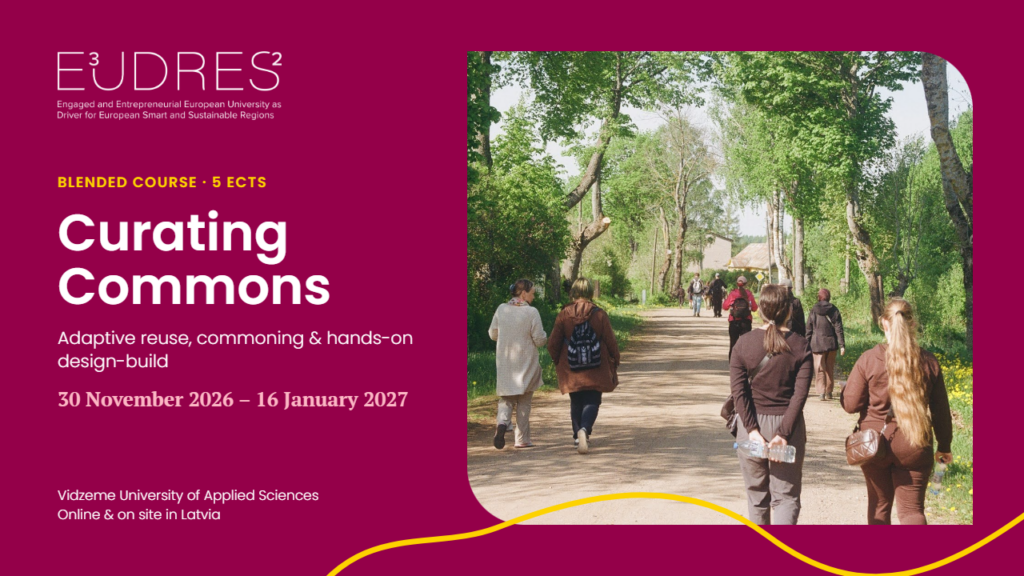
The course combines online lectures and methodological preparation with an intensive hands-on design-build workshops in Latvia and Romania. The online component introduces students to territorial reading and mapping, anthropological approaches to communities, theories of commons and commoning, adaptive reuse and circular construction, and research-by-design methodologies. During the physical workshop, students work in international and interdisciplinary teams, engaging with local people and places through walking, observation, conversations, mapping, collaborative design and hands-on construction. Working with locally available resources where possible, participants develop and implement small-scale, context-sensitive spatial interventions in response to identified local needs and opportunities.
The course emphasises learning through making, intercultural exchange and critical reflection on the role of spatial practitioners. Rather than imposing predetermined solutions, participants explore how collaborative processes and modest interventions can support shared spaces, strengthen relationships and create possibilities for continued use and care.
Theoretical module and workshops can be completed independently and each award particular number of ECTS.
Details
Schedule
Online sessions (17:30 – 20:40 EET / 16:30 – 19:40 CET):
30 November 2026
2 December 2026
10 December 2026
17 December 2026
7 January 2027
On-site design-build workshop:
9 – 16 January 2027 in Latvia
or summer 2027 in Romania
Course Content
The course consists of two complementary components combining theoretical learning and practical spatial experimentation.
Online theoretical module (2 ECTS)
- Territorial reading and mapping: spatial, social, cultural and environmental dynamics; methods of territorial analysis; identification of local resources and opportunities
- People, place and everyday practices: anthropological perspectives on communities, local knowledge, community engagement and ethical fieldwork methods
- Commons and commoning: theoretical foundations, shared resources, collective governance, spatial agency and collective care
- Adaptive reuse and circular construction: theoretical principles, material recovery, repair, low-impact construction strategies and case studies
- Research-by-design and situated interventions: design and making as methods of inquiry, prototyping, iterative experimentation and critical reflection.
Intensive design-build workshop (3 ECTS if Latvian workshop, 2 ECTS if Romanian workshop)
- Territorial exploration through walking, observation and mapping
- Engagement with local communities and identification of local needs and resources
- Collaborative concept development and spatial experimentation
- Material sourcing, preparation and hands-on construction
- Documentation, presentation and critical reflection on the process and its outcomes.
The theoretical and practical components can be completed independently, with successful completion of both awarding a total of 5 ECTS or 4 ECTS.
Tutors
Marija Katrīna Dambe, Bogdan Isopescu
Study Programme
Sustainable Construction
Course Level
Bachelor level (EQF 6)
ECTS
5 (2 ECTS online theoretical module + 3 ECTS Latvian workshop or 2 ECTS Romanian workshop; check “Recognition of ECTS” section for more information)
Contact Hours
15 hours online, plus the on-site design-build workshop
Prerequisites
No specific prior knowledge or professional experience is required.
The course is open to Bachelor’s, Master’s and PhD students in architecture, spatial planning, construction, sustainability, design, arts, anthropology, social sciences and related disciplines.
Participants should demonstrate an interest in interdisciplinary collaboration, sustainable spatial practices and community engagement, as well as a willingness to participate in hands-on activities and work in an international team.
A sufficient level of English to participate in discussions, collaborative work and presentations is required.
Further information
Recognition of ECTS
Please note that the recognition of the ECTS provided through this activity on your Transcript of Records depends on the decision of the responsible E³UDRES² coordinators or academic authority of your study programme at your home institution. We strongly recommend contacting them before starting an activity that awards ECTS in order to avoid any unexpected difficulties later on.
Depending on their decision, one of the following scenarios may apply:
- Your credits are recognised and can replace another course within your regular study programme.
- Your credits are recognised and can be included in the elective or free-choice space of your study programme (if applicable).
- Your credits are recognised as extra-curricular, meaning they cannot replace another course or be included in the elective or free-choice space of your programme (if applicable).
When contacting the responsible E³UDRES² coordinators at your home institution, please ensure you provide all relevant information about the E³UDRES² activity so they can properly evaluate your request.
Teaching Methods
Blended learning, online lectures, guest lectures, seminars, guided discussions, case-based learning, self-study, practical exercises, fieldwork, territorial mapping, project-based learning, challenge-based learning, interdisciplinary group work, research-by-design, hands-on design-build workshops, prototyping, tutorials, peer learning, presentations and critical reflection.
The course emphasises experiential learning and learning through making, combining theoretical knowledge with its application in real-life contexts.
Learning Outcomes
Upon successful completion of the course, students will be able to:
- Explain the principles of commons, commoning and community co-production
- Analyse territories through spatial mapping, observation and anthropological fieldwork methods
- Identify existing spatial, material and social resources and opportunities for intervention
- Apply adaptive reuse, circular construction and low-impact design principles
- Develop context-sensitive spatial interventions through research-by-design, prototyping and hands-on experimentation
- Collaborate in international and interdisciplinary teams and engage responsibly with local communities
- Critically evaluate the social, spatial and environmental implications of interventions, including their future use, maintenance and collective care
- Document, communicate and reflect on the knowledge generated through situated experimentation and collaborative making.
Assessment
Assessment is continuous, process-oriented and project-based, considering both individual contributions and collective outcomes.
Please note
Please be aware of the course timezone provided in the course description. Converting the course times to your timezone may be necessary to ensure your availability.